
Avenged Sevenfold — Biography, Band Members, Albums, Songs and Metal Legacy
Avenged Sevenfold is an American metal band formed in Huntington Beach, California, in 1999. Often shortened to A7X, the group built its reputation on forceful metalcore, melodic twin-guitar writing and a willingness to change direction. Its catalog connects the early urgency of Waking the Fallen, the hard-rock scale of City of Evil and the progressive and experimental ambitions of later records.
The band’s story is also a story about musical roles: M. Shadows’ voice, Synyster Gates and Zacky Vengeance’s interlocking guitars, Johnny Christ’s bass, and the contrasting approaches of the drummers who have shaped different eras. The late Jimmy “The Rev” Sullivan remains essential to that history. Brooks Wackerman is the current drummer.
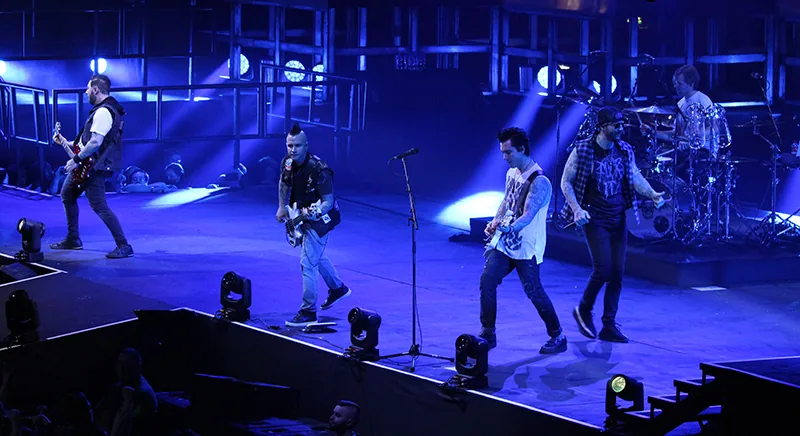
Who is Avenged Sevenfold?
A7X emerged from Southern California’s heavy-music community and developed into an international touring band. Its identity is difficult to reduce to one subgenre. Screamed vocals and tightly organized riffing dominate much of the early work; later releases make greater room for clean singing, theatrical arrangements, extended forms and electronic textures.
The most useful introduction is a sequence of records rather than a single label. Waking the Fallen establishes the contrast between aggression and melody. City of Evil pushes guitar leads and clean vocals forward. The Stage and Life Is But a Dream… show how far the band would eventually stretch its arrangements.
Formation and early years in Huntington Beach
The original 1999 lineup included singer M. Shadows, guitarist Zacky Vengeance, drummer The Rev and bassist Matt Wendt. They began as young musicians with overlapping interests in punk, hardcore and metal. Subsequent personnel changes produced the familiar five-piece configuration with two guitarists.
Synyster Gates joined during the early period, and Johnny Christ became the long-term bassist. Those changes mattered musically as well as visually: two distinct guitar parts could now operate as a melody-and-harmony pair, a riff-and-lead combination or a single coordinated rhythmic voice. Earlier bassists also included Justin Sane and Dameon Ash; they should not be confused with the later established lineup.
Early recordings and the metalcore foundation
Sounding the Seventh Trumpet appeared in 2001 through Good Life Recordings. Waking the Fallen, released by Hopeless Records in 2003, brought a more developed balance of heavy passages and melody. “Unholy Confessions” became a key entry point into the band’s early sound.
The importance of that era is structural. A riff can act as the hook before the singer enters, and a change in vocal delivery can redraw a section without requiring an entirely different band sound. That relationship between riff, voice and contrasting sections continued even when the group moved beyond its early metalcore vocabulary.
City of Evil and the breakthrough
Released in 2005, City of Evil was the decisive expansion into a wider audience. “Bat Country,” “Beast and the Harlot” and “Seize the Day” introduced many listeners to a band built around clean vocals, busy guitar arrangements and large melodic gestures. The record helped establish A7X beyond the scene that had supported its earliest releases.
The shift toward clean singing was an artistic development. Reducing it to a simple story about a singer being forced to abandon screaming obscures the band’s stated musical intentions. Guitar became an increasingly prominent narrative voice, with instrumental passages carrying momentum and emotional changes between vocal sections.
City of Evil in the catalog
For a future album retrospective, City of Evil offers a particularly revealing meeting point between the earlier band and its later ambitions. This biography provides career context; a separate retrospective will be the place for a sustained song-by-song assessment.
Avenged Sevenfold’s major songs: a listening guide
- “Unholy Confessions” — a starting point for the Waking the Fallen period and the role of the guitar riff in the band’s identity.
- “Bat Country” — a signature City of Evil recording and a useful introduction to the group’s melodic hard-rock reach.
- “Afterlife” and “Almost Easy” — major songs from the 2007 self-titled album, showing the band’s growing appetite for sharply differentiated arrangements.
- “A Little Piece of Heaven” — a theatrical composition closely associated with The Rev’s writing and the group’s ensemble approach.
- “Nightmare” and “So Far Away” — contrasting entry points into the emotionally charged 2010 album.
- “Hail to the King” — a direct route into the band’s more spacious, classic-metal-oriented 2013 period.
- “The Stage” — the title song that represents the band’s progressive ambitions and earned a Grammy nomination.
- “Nobody” — an introduction to the darker, more experimental world of Life Is But a Dream….
This is a career listening guide rather than a chart ranking. A song’s usefulness in understanding the band is different from its commercial position.
Albums and discography
| Year | Studio album | Career context |
|---|---|---|
| 2001 | Sounding the Seventh Trumpet | Debut and early heavy-music foundation |
| 2003 | Waking the Fallen | Metalcore development and melodic contrasts |
| 2005 | City of Evil | Breakthrough into a broader rock audience |
| 2007 | Avenged Sevenfold | Expanded theatrical and stylistic range |
| 2010 | Nightmare | Completed following The Rev’s death |
| 2013 | Hail to the King | More direct classic-metal arrangements |
| 2016 | The Stage | Progressive forms and conceptual ambition |
| 2023 | Life Is But a Dream… | Experimental studio album |
These are the eight principal studio albums through the latest full-length listed here. Live albums, compilations and EPs serve different purposes. The 2026 STATICA project is discussed separately below rather than counted as a ninth studio album.
Avenged Sevenfold band members
Current lineup
- M. Shadows — Matthew Sanders: lead vocals.
- Synyster Gates — Brian Haner Jr.: lead guitar and vocals.
- Zacky Vengeance — Zachary Baker: rhythm guitar and vocals.
- Johnny Christ — Jonathan Seward: bass and vocals.
- Brooks Wackerman: drums; officially announced as a member in 2015.
Former members and recording collaborators
The Rev, James Owen Sullivan, was a founding drummer, singer and songwriter. He died on December 28, 2009. Mike Portnoy subsequently played drums on Nightmare and toured with the band; that contribution should be distinguished from permanent founding membership. Arin Ilejay played drums during the following era, including Hail to the King, before the band announced their separation in 2015.
Synyster Gates and Zacky Vengeance: the two-guitar language
The labels “lead” and “rhythm” describe responsibilities, but they do not fully explain the partnership. Vengeance’s rhythm work gives a lead line its harmonic and rhythmic setting. Gates’ solo can develop from material established elsewhere in the arrangement. When both parts move together, the guitars become a combined melodic instrument.
Harmonized leads and arrangement
In a 2010 Guitar World interview, Gates identified the Eagles’ “Hotel California,” Boston, Dream Theater and Mr. Bungle as different models for harmony. That range helps explain why A7X’s twin leads are more than a tribute to one metal tradition. Two lines can make a melody sound larger while retaining separate contours.
A later band interview about The Stage described the chorus guitars in “God Damn” as functioning like arranged strings or backing voices. This is a useful way to understand harmonization: each part has a job inside the chord, and the combined movement matters as much as the speed of either guitarist.
Alternate picking, sweep picking and economy picking
Alternate picking uses successive downstrokes and upstrokes. Sweep picking moves the pick through neighboring strings in a coordinated direction, commonly across an arpeggio. Economy picking combines approaches to reduce unnecessary movement. These terms describe how notes are articulated; they do not, by themselves, explain why a solo works.
In a guitar-school interview with Loudwire, Gates credited Frank Gambale’s economy-picking approach as an important part of his development. The significance is musical efficiency: difficult material can become easier to connect when the picking hand follows the shape of a phrase. A fast passage should not automatically be labeled a sweep without evidence of how it is played.
Tapping, legato and melodic phrasing
Tapping brings the picking hand onto the fingerboard to sound notes. Legato connects notes through techniques such as hammer-ons and pull-offs rather than picking every attack. Gates has discussed these tools alongside other technical approaches, but his broader point is that technique serves a composition. The melodic line, its placement and its destination remain the listener’s guide.
“So Far Away” offers a useful contrast to the band’s more athletic writing: the guitar’s expressive role does not depend on sustained velocity. It also helps explain why a biography of these players should consider slower passages alongside the most demanding solos.
Rhythm guitar, tone and instrumental passages
Vengeance’s background includes punk and metal listening, while Gates’ formal study included jazz and fusion. Those histories create different resources for a shared arrangement. Clear rhythm articulation lets dense lead writing remain legible; a sustained or harmonized line can then stand apart from a tightly defined riff.
Both guitarists have established associations with Schecter signature instruments. Equipment changes over time, and a signature model does not establish the exact recording chain for an album. Tone also depends on playing, arrangement and production, so this guide avoids assigning unverified amplifier settings or studio specifications.
In his analysis of “Nobody,” MusicRadar writer Rob Laing highlighted the weight of the central riff and the extended solo following an orchestral passage. That source-based example shows the guitar functioning inside a larger dramatic sequence. The solo’s role is not simply to pause the song for a technical display.
M. Shadows and the vocal evolution
Shadows’ movement from the early harsh-and-clean contrast toward predominantly clean singing gave the band different ways to shape a song. A melodic vocal can sit alongside a harmonized lead rather than compete with a heavy riff for rhythmic force. On later records, vocal textures become another variable in an increasingly broad production palette.
That change also helps explain why different listeners enter the catalog at different places. Someone drawn to Waking the Fallen may value its tension between deliveries; someone arriving through “Seize the Day” may first hear the band as a melodic rock act. Both routes lead into the same evolving catalog.
The Rev’s contributions and legacy
Sullivan’s role extended well beyond keeping time. His drumming, singing and compositional ideas shaped the group’s character, with “A Little Piece of Heaven” providing an especially clear example of the theatrical possibilities in his writing. The band’s own “Breakdown” discussion of the track documents how an initial idea became a collective arrangement.
His death made Nightmare a record heard through loss as well as musical development. Portnoy’s contribution helped the band complete it, but the finished album belongs in a history that recognizes Sullivan’s creative presence. Later drummers brought their own strengths rather than erasing that earlier identity.
Songwriting and musical evolution
A7X’s development involves changes in scale and pacing as much as changes in heaviness. The self-titled 2007 album widened its theatrical possibilities. Nightmare combined forceful material and more reflective writing. Hail to the King allowed simpler, more spacious arrangements to carry greater weight.
The Stage moved toward extended structures and a more overt progressive framework. Its title song’s changes of harmonic setting illustrate how tension can come from relationships between sections. Life Is But a Dream… took another step away from a fixed formula, making contrast itself central to the album’s identity.
Life Is But a Dream… and experimental music
Released on June 2, 2023, Life Is But a Dream… was produced by Avenged Sevenfold and Joe Barresi, with mixing by Andy Wallace. The band and label presented it as a particularly adventurous release. Its official campaign included “Nobody” and “We Love You.”
In the wider career, the record demonstrates that progressive development does not have to mean adding more notes. Changing the relationship between voice, guitar, orchestral sound and electronic production can be equally disruptive. It is a useful endpoint for a first trip through the full-length albums, but not a final limit on what the musicians may attempt.
Awards, milestones and live performance
Nightmare and Hail to the King both reached No. 1 on the Billboard 200. “The Stage” received a Best Rock Song nomination at the 2018 Grammy Awards. A nomination is distinct from a win, and neither achievement captures the entire history of the band’s following.
The live catalog offers another perspective on the arrangements. Live in the LBC documents the group during the late-2000s era, when material from several records had to work together in one set. More recently, the band’s 2026 North American tour with Good Charlotte connected its current activity to a much longer concert history. For changing schedules and ticket information, use the official band website.
Official music and performance examples
“Bat Country” — the breakthrough era
Watch the official “Bat Country” video.
“Unholy Confessions” — Live in the LBC
This official live recording provides a performance comparison with the studio-era discussion above. Listen on the official artist channel.
“Nobody” — the experimental era
Watch the official “Nobody” video.
Recent music: Magic, STATICA and current activity
The single “Magic” arrived in December 2025. In July 2026, the four-track STATICA EP introduced another electronic-oriented experiment, accompanied by a video on the band’s official channel. It is treated here as an EP and related creative project, separate from the eight-album studio chronology.
That distinction keeps the biography useful as releases accumulate. New work can be added without retrospectively forcing every project into the same format or musical category. The official news archive and official streaming catalog provide routes to subsequent announcements and releases.
Avenged Sevenfold’s influence and lasting legacy
A7X’s place in modern metal rests on the connection between melodic immediacy and musical ambition. The band helped bring elaborate guitar partnerships and theatrical songwriting to a broad audience while repeatedly challenging the expectations attached to its earlier success. The resulting catalog contains distinct eras rather than a single sound repeated indefinitely.
Readers exploring other paths through heavy music can continue with the site’s histories of Bullet for My Valentine, Megadeth and Pierce the Veil. These are editorial listening connections, not claims of collaboration. The Falling in Reverse profile offers another example of a heavy band changing its stylistic boundaries. Return to the Rock & Metal hub or artist directory to keep exploring.
Sources and further reading
- Avenged Sevenfold — official website and album archive.
- AllMusic — biography and discography.
- Official announcement: Brooks Wackerman joins.
- Guitar World — Gates and Vengeance interview.
- Loudwire — Gates on learning and technique.
- Band archive — The Stage guitar interview.
- MusicRadar — “Nobody” guitar analysis.
- Official Breakdown — “A Little Piece of Heaven”.
- Recording Academy — “The Stage” nomination.
- Official STATICA video and Kerrang! — 2026 EP report.
Career and current-lineup information checked November 2026.