
Few artists have shaped American music and popular culture as completely as Dolly Parton. Across seven decades, the singer-songwriter from East Tennessee grew from a child performing in the Great Smoky Mountains into a country legend, crossover superstar, actress, entrepreneur, philanthropist, and one of the most recognizable public figures in the world.
Behind the rhinestones, towering blond hair, and quick humor was a disciplined songwriter and unusually perceptive businesswoman. Parton understood publishing ownership, artistic independence, branding, and long-term career building decades before those subjects became common conversations among recording artists.
Her catalog includes country standards such as “Coat of Many Colors,” “Jolene,” “Joshua,” “My Tennessee Mountain Home,” “The Bargain Store,” “9 to 5,” and “I Will Always Love You.” She earned 10 competitive Grammy Awards from 55 nominations, entered the Country Legends canon, joined the Country Music Hall of Fame in 1999 and the Rock & Roll Hall of Fame in 2022, and received honors spanning music, film, public service, and philanthropy.
This complete Dolly Parton biography explores her childhood, songs, albums, partnership with Porter Wagoner, marriage to Carl Dean, film career, business achievements, charitable work, death on August 25, 2026, and enduring influence on country music.
Dolly Parton Quick Facts
| Full name | Dolly Rebecca Parton |
|---|---|
| Born | January 19, 1946, near Sevierville, Tennessee |
| Died | August 25, 2026, in Nashville, Tennessee (age 80) |
| Known for | Songwriting, country and pop music, film, Dollywood, and philanthropy |
| Signature songs | “Jolene,” “I Will Always Love You,” “Coat of Many Colors,” and “9 to 5” |
| Spouse | Carl Thomas Dean (married 1966–2025) |
| Major institutions | Dollywood and Dolly Parton’s Imagination Library |
Explore Dolly Parton’s Life and Career
- Early life in the Great Smoky Mountains
- The Porter Wagoner years
- Essential Dolly Parton songs
- Dollywood and business success
- Awards and major honors
- Dolly Parton’s death in 2026
- Frequently asked questions
Birth in the Great Smoky Mountains
Dolly Rebecca Parton was born on January 19, 1946, in rural East Tennessee, near Sevierville in the community generally identified as Locust Ridge. She was the fourth of twelve children born to Robert Lee Parton Sr., commonly called Lee, and Avie Lee Caroline Owens Parton.
The Partons lived in a small cabin in the foothills of the Great Smoky Mountains. The Country Music Hall of Fame describes the home as being roughly fifteen miles east of Sevierville, without plumbing, electricity, or an access road. Poverty was not a colorful bit of mythology added later to Parton’s biography; material deprivation was a fundamental part of her childhood.
Her father worked relentlessly at whatever jobs were available, including farming and construction-related labor. Though he lacked formal education and never learned to read or write, Dolly later spoke frequently about his intelligence, business instincts, work ethic, and determination that his children receive opportunities he had not had.
Her mother provided another major part of Dolly’s inheritance: music and storytelling. Avie Lee sang traditional songs, church music, and old folk ballads that had traveled through generations of Appalachian families. The Country Music Hall of Fame notes that she taught Dolly both church music and traditional ballads with roots reaching back to the British Isles. Music existed throughout the extended family as well. Dolly’s maternal grandfather was a preacher and musician, and various aunts, uncles, brothers, and sisters sang or played instruments.
For Dolly, therefore, music was not initially an industry. It was part of the language of family life.
She sang in church as a small child and began inventing songs almost as soon as she understood that songs could be written. The Library of Congress dates one of her earliest compositions, “Little Tiny Tassle Top,” to 1951, when Dolly would have been about five. The song concerned a homemade doll. A couple of years later she improvised an instrument from an old mandolin and strings before eventually receiving a real guitar.
This tendency—to transform ordinary, sometimes painful childhood experiences into stories—would become the foundation of her songwriting.
Poverty, Imagination, and “Coat of Many Colors”
Parton never denied the poverty of her childhood, but neither did she allow outsiders to reduce her family to it. Her songs frequently described hardship with an unusual combination of realism, affection, humor, pride, and emotional complexity.
The most famous example became “Coat of Many Colors.”
According to the story Parton later turned into the song, her mother made her a coat from pieces of leftover fabric. While sewing it together, Avie Lee told her daughter the biblical story of Joseph and his coat of many colors. Dolly proudly wore the homemade coat to school, only to be mocked by classmates because the garment revealed her family’s poverty.
Instead of writing the experience simply as a story of humiliation, Parton transformed it into a statement about value. The child in the song possesses something money cannot provide: the love with which the coat was made.
“Coat of Many Colors,” released as a single in 1971, reached No. 4 on the country chart and eventually became one of Parton’s signature compositions. It demonstrated one of her greatest abilities as a writer—taking a highly personal story from an isolated Appalachian childhood and making its emotional meaning understandable to people who had never been anywhere near the Smoky Mountains.
That ability would follow her for the rest of her career.
Uncle Bill Owens and the First Steps Toward a Career
Among the relatives who recognized Dolly’s unusual ambition, perhaps none was more consequential than her uncle Bill Owens.
Owens encouraged her songwriting, helped teach her guitar, transported her to performances, introduced her to people in the music business, and eventually became her songwriting partner. Dolly repeatedly credited him with helping convert her childhood dream into a realistic professional pursuit.
By about age ten, she was appearing regularly on Knoxville businessman Cas Walker’s radio and television program, The Cas Walker Farm and Home Hour. For a child from Locust Ridge, Knoxville represented a significant stage. More importantly, it put her in contact with professional musicians and people connected to Nashville.
At eleven, Dolly co-wrote “Puppy Love” with Owens. She traveled with her grandmother Rena Owens by bus to Lake Charles, Louisiana, where she recorded the song for Goldband Records. It was released in 1959, when Dolly was thirteen. The record did not become a commercial hit, but it gave a remarkably young Parton her first experience making a professional record.
That same year came an even more important moment.
Dolly and Bill Owens traveled to Nashville hoping to get her onto the Grand Ole Opry. Because she was so young, securing a performance was not straightforward. Friends Carl and Pearl Butler helped persuade Opry star Jimmy C. Newman to surrender one of his Saturday-night spots to her.
On July 25, 1959, thirteen-year-old Dolly Parton walked onto the stage of the Ryman Auditorium.
Johnny Cash introduced her.
Parton sang George Jones’ “You Gotta Be My Baby.” According to her official history, the audience demanded three encores.
For a girl who had grown up listening to the Grand Ole Opry on the radio, the experience confirmed something she already believed with extraordinary certainty: Nashville was where she belonged.
Teenager, Songwriter, and Repeated Rejection
Parton’s early exposure did not mean Nashville immediately embraced her.
In 1962, Dolly and Bill Owens obtained deals with Tree Publishing and Mercury Records. She recorded “It’s Sure Gonna Hurt,” backed by “The Love You Gave,” but the record failed to chart. Mercury and Tree dropped them.
She continued.
In 1963 she appeared on the budget album Hits Made Famous by Country Queens, singing material associated with established female country stars such as Kitty Wells.
Then in 1965, producer and Monument Records founder Fred Foster signed Parton and Owens to his Combine publishing operation and brought Dolly to Monument Records. Even then, there was uncertainty about how to market her. She was initially steered partly toward pop material rather than the country music she wanted to make.
Her biggest early break did not immediately arrive through her own voice. It came through her writing.
In 1966, country singer Bill Phillips recorded two compositions written by Parton and Owens, “Put It Off Until Tomorrow” and “The Company You Keep.” Both became Top 10 country hits.
Nashville finally had evidence that the young woman from East Tennessee could write commercially successful songs.
Then came “Dumb Blonde.”
Released in 1966 and included on her debut album Hello, I’m Dolly in 1967, “Dumb Blonde” became her first significant charting solo record. Its title also hinted at something that would become central to Parton’s public identity: she understood exactly how others perceived her, and she was more than willing to exploit their assumptions.
Moving to Nashville—and Meeting Carl Dean
Parton graduated from Sevier County High School in 1964.
The next day, she left for Nashville.
She was eighteen.
On her first day in the city, she met the man who would remain her husband for nearly sixty years.
Carl Thomas Dean encountered Dolly outside the Wishy Washy Laundromat. Dean was a Nashville native who eventually operated an asphalt-paving business and possessed almost the exact opposite temperament from his future wife when it came to publicity. While Dolly became one of the most photographed women in entertainment, Carl avoided cameras and celebrity events whenever possible.
They married on May 30, 1966, in Ringgold, Georgia.
Their marriage became one of the most unusual long-running relationships in show business precisely because Dean largely refused to participate in show business at all. Parton traveled, recorded, filmed movies, attended awards ceremonies, and built an international entertainment empire while Carl maintained a comparatively private existence.
They never had children. Dolly nevertheless developed particularly close relationships with nieces, nephews, younger performers, and her goddaughter Miley Cyrus. Her relatives even gave her the affectionate family nickname “Aunt Granny.”
Carl Dean remained her husband until his death on March 3, 2025, at age 82.
But in 1967, the young couple could not have known just how enormous Dolly’s career was about to become.
Porter Wagoner Changes Everything
The decisive breakthrough arrived when country star Porter Wagoner needed a female performer for his nationally syndicated television program, The Porter Wagoner Show.
Norma Jean, Wagoner’s popular female singing partner, was leaving.
Dolly Parton was recruited as her replacement in 1967.
The transition was not instantly comfortable. Some members of Wagoner’s audience wanted Norma Jean back, and Dolly had to win them over. But the pairing soon became enormously successful.
Wagoner was already an established star. His television show gave Dolly weekly exposure throughout a huge portion of rural America. Their visual contrast was memorable: Wagoner in elaborate Nudie suits and towering blond pompadour, Parton in increasingly flamboyant dresses and enormous hair. More importantly, their voices blended exceptionally well.
RCA Victor signed Parton, both as Wagoner’s duet partner and as a solo performer.
Their first major duet recording, Tom Paxton’s “The Last Thing on My Mind,” became a Top 10 country hit. It began a long string of successful Wagoner-Parton recordings, including “Just Someone I Used to Know,” “Tomorrow Is Forever,” “Daddy Was an Old Time Preacher Man,” “Better Move It on Home,” and “Please Don’t Stop Loving Me.”
The partnership was artistically productive—but complicated.
Wagoner gave Parton an enormous platform and helped guide her career. He also produced her records and had substantial professional influence over her. As Dolly’s own hits multiplied and her ambitions expanded, the relationship increasingly became a struggle over independence.
Dolly Parton Becomes a Solo Star
By the beginning of the 1970s, Dolly Parton no longer needed to be introduced merely as Porter’s “girl singer.”
Her songwriting was becoming too distinctive and her recordings too successful.
“Mule Skinner Blues (Blue Yodel No. 8)” became a major hit in 1970. Then, in 1971, “Joshua” became Parton’s first solo No. 1 country single. “Coat of Many Colors” followed later that year.
Songs including “Touch Your Woman,” “My Tennessee Mountain Home,” and “Traveling Man” demonstrated that Parton’s writing extended far beyond conventional love songs. She wrote about poverty, migration, mothers, children, sex, social hypocrisy, death, jealousy, faith, and women attempting to control their own lives.
The Country Music Hall of Fame regards the early-to-mid-1970s as perhaps the most creatively fertile period of her country career. Her 1973 album My Tennessee Mountain Home was effectively a musical memoir—a complicated love letter to the Appalachian world she cherished but had also been determined to escape.
Then came 1973 and 1974.
Within a remarkably concentrated period, Dolly Parton wrote and recorded two songs that would define not merely her career, but American popular music.
“Jolene”
“Jolene” is built around a remarkably simple dramatic situation: one woman begs another woman not to take her man.
Parton said the name itself came from a young fan she met after a performance. The emotional scenario, she later explained, was influenced by a beautiful bank employee whose friendliness toward Carl Dean had made Dolly jealous.
Instead of writing the presumed romantic rival as a villain, Parton did something more interesting. The narrator is overwhelmed by Jolene’s beauty and openly acknowledges her own vulnerability.
The song’s instantly recognizable guitar figure, driving rhythm, haunting melody, and desperate lyric made it one of the most enduring recordings in country history.
“Jolene” reached No. 1 on the country chart in 1974.
Decades later, it continued to be recorded by artists across country, rock, pop, bluegrass, and alternative music. The Rock & Roll Hall of Fame identifies it as one of the essential works demonstrating Parton’s ability to cross musical boundaries while retaining her Appalachian musical identity.
But the song that followed it carried even greater long-term consequences.
Leaving Porter Wagoner and Writing “I Will Always Love You”
By 1973, Parton wanted to leave The Porter Wagoner Show and operate independently.
Wagoner resisted.
Rather than end the partnership through another argument, Dolly did what she understood better than almost anything else: she wrote a song.
“I Will Always Love You” was not originally a romantic breakup song. It was a farewell to Porter Wagoner.
The lyric simultaneously communicated affection, gratitude, sadness, and determination. Parton played the song for Wagoner. The emotional power of the composition reportedly moved him deeply, and he accepted that she was leaving.
The recording became a No. 1 country hit in 1974.
The decision Dolly made afterward became one of the most celebrated examples of business judgment in music history.
Elvis Presley wanted to record the song.
Parton was thrilled. Then, immediately before the planned recording session, Elvis’s manager Colonel Tom Parker informed her that Presley generally did not record outside compositions unless his organization received a substantial portion of the publishing rights—Parton remembered the request as at least half.
She refused.
Parton later recalled being devastated by the decision because she adored Elvis. But she understood that the copyright was too valuable to surrender.
Years later she described the song as property she intended to leave to her family.
The decision would eventually prove worth millions.
Independence and the Pop Crossover
Parton formally departed Wagoner’s television show in 1974, although contractual ties meant he continued producing some of her recordings into the mid-1970s.
Her solo career accelerated.
“Love Is Like a Butterfly” became another No. 1. “The Bargain Store” reached No. 1 in 1975. During the period she was named the Country Music Association’s Female Vocalist of the Year in both 1975 and 1976.
But Dolly wanted a larger audience.
She did not want to abandon country music. She wanted country music—and herself—to travel beyond the boundaries Nashville imposed on it.
The move was controversial.
Parton worked with pop-oriented producers and adopted increasingly polished arrangements. In 1977 she released Here You Come Again. The title song became a massive crossover hit, reaching No. 3 on the Billboard Hot 100, while the album became her first to enter the Top 20 of the Billboard 200.
The album became her first million-selling LP, and “Here You Come Again” earned Parton her first Grammy Award.
Some traditional country listeners accused her of abandoning the genre.
Parton’s response, in effect, was that she had not left country music—she was simply refusing to let country music determine the limits of her career.
The CMA named her Entertainer of the Year in 1978.
By then, Dolly Parton was no longer merely a country star.
She was becoming an American celebrity.
Creating the Dolly Image
Her appearance deserves attention because Parton treated image with almost the same intentionality that she treated songwriting.
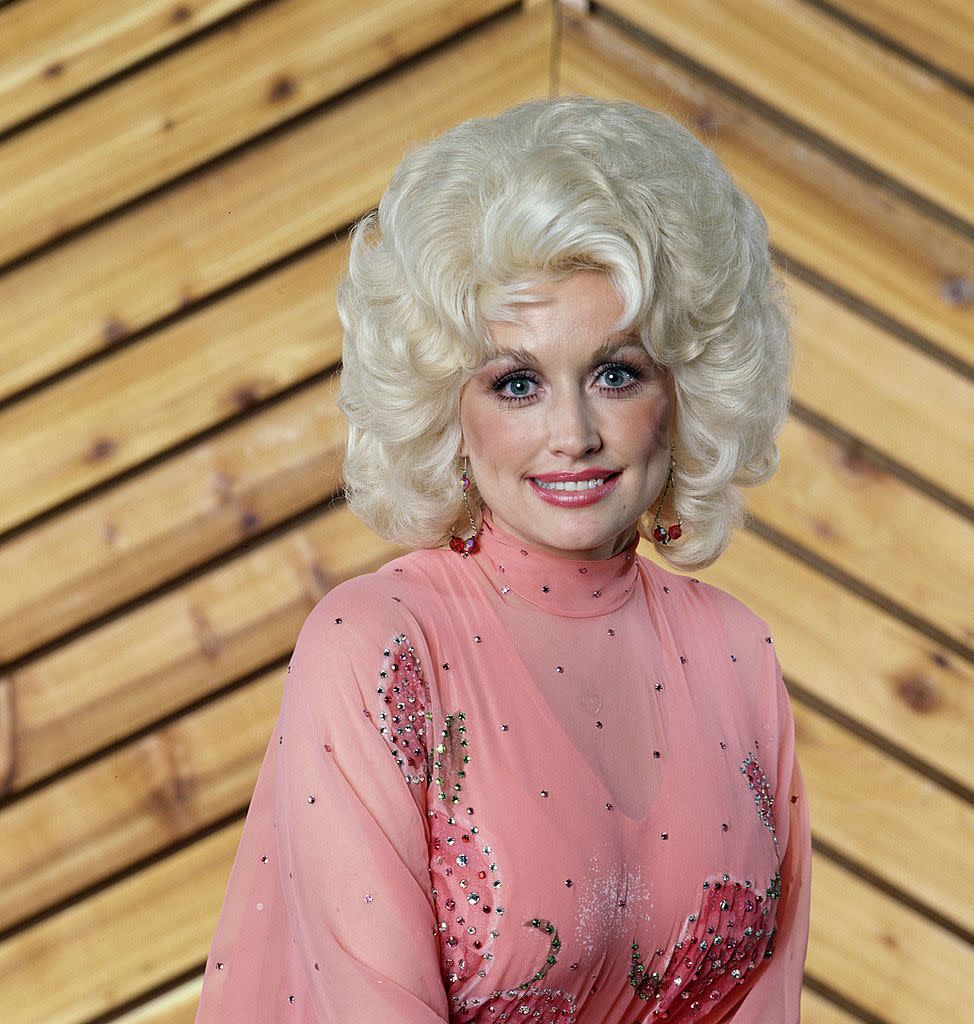
The enormous blond hair, dramatic makeup, fitted clothing, high heels, sequins, rhinestones, and exaggerated femininity were not evidence that Parton did not understand sophistication. They were evidence that she understood performance.
She famously said that her childhood idea of glamour had been inspired partly by a flamboyantly dressed local woman whom respectable townspeople considered “trash.” Young Dolly saw something entirely different: beauty.
When Nashville executives later suggested that toning down her appearance might cause people to take her more seriously, she refused.
The Country Music Hall of Fame’s 2025–2026 Dolly Parton: Journey of a Seeker exhibition specifically identified that decision as one of the major turning points of her career. She understood that standing out was an asset.
The image also became a defensive weapon.
Parton told jokes about her body, wigs, clothes, and intelligence before anyone else could. By exaggerating the caricature, she controlled it.
People could underestimate Dolly Parton.
They simply could not do so for very long.
“9 to 5” and Hollywood Stardom
Jane Fonda saw something beyond the country-music persona and wanted Parton for the 1980 workplace comedy 9 to 5.
Parton had never acted in a feature film.
She accepted.
Alongside Fonda and Lily Tomlin, Dolly played Doralee Rhodes, a secretary dealing with a sexist and manipulative boss. The movie became a major commercial success and transformed Parton into a legitimate film star.
Then Dolly wrote the title song.
She reportedly developed the rhythm by clicking her acrylic fingernails together, reproducing the sound of a typewriter while working on set.
“9 to 5” became one of her biggest recordings, reaching the top of the Billboard Hot 100 and country charts. It earned two Grammy Awards and an Academy Award nomination for Best Original Song.
The film also gave Dolly an enduring association with working women. Though Parton often resisted political labels, the song’s depiction of employees whose labor enriches people above them carried an unmistakable message about workplace inequality.
Her acting career continued with The Best Little Whorehouse in Texas in 1982, in which she starred opposite Burt Reynolds. For the film, she rerecorded “I Will Always Love You.”
Remarkably, the new version again reached No. 1 on the country chart.
Other films followed, including Rhinestone with Sylvester Stallone, Steel Magnolias, Straight Talk, and later television films and specials.
Not every project succeeded. Rhinestone in particular received poor reviews.
But Dolly had now achieved something few Nashville stars had managed: she could move between records, concerts, television, movies, and mainstream celebrity without ceasing to be recognizably Dolly Parton.
Kenny Rogers and “Islands in the Stream”
Another defining recording arrived in 1983.
The Bee Gees had written “Islands in the Stream,” and Kenny Rogers was working on the song with producer Barry Gibb. Dolly joined the recording, transforming it into a duet.
The result became enormous.
“Islands in the Stream” reached No. 1 on the Billboard Hot 100 and became one of the most recognizable duets in American popular music.
Rogers and Parton developed a lifelong friendship and continued performing and recording together, including the holiday album Once Upon a Christmas and later “You Can’t Make Old Friends.”
Their chemistry fueled decades of joking speculation that their relationship had been romantic, something both repeatedly denied.
What unquestionably existed was an unusually successful musical partnership.
Trio and Country Royalty
Parton’s ability to collaborate reached another peak in 1987 with Linda Ronstadt and Emmylou Harris.
The three singers had wanted to record together for years, but scheduling and record-label complications delayed the project.
When Trio finally appeared, it became both a commercial and critical success. The album reached No. 1 on the country chart and earned a Grammy for Best Country Performance by a Duo or Group with Vocal.
They reunited for Trio II, released in 1999. Their performance of Neil Young’s “After the Gold Rush” earned another Grammy.
Parton also joined Loretta Lynn and Tammy Wynette for the 1993 album Honky Tonk Angels.
These projects placed her alongside the women who had reshaped the possibilities available to female country performers during the second half of the twentieth century.
Dollywood: Bringing the Money Home
Parton’s success in entertainment gave her another opportunity: economic development in the region where she had grown up.
In the mid-1980s she partnered with Jack and Pete Herschend, whose family operated Silver Dollar City Tennessee in Pigeon Forge.
On May 3, 1986, the renamed and expanded Dollywood opened.
The decision was both sentimental and strategic.
Parton wanted tourists to experience the culture and landscape of the Great Smoky Mountains, but she also wanted tourism to create employment for people in East Tennessee. Rather than simply become wealthy and leave home behind, she helped build an industry that brought money into her home county.
The park’s first season drew roughly 1.3 million visitors, about 75 percent more than Silver Dollar City’s previous season. Dollywood subsequently expanded dramatically and became Tennessee’s most-visited ticketed attraction and one of America’s best-known theme parks.
Parton and Herschend Family Enterprises remained partners for the next four decades.
Dollywood expanded beyond rides into lodging, entertainment, Splash Country water park, restaurants, festivals, and other tourism ventures. In 2023, the park received five Golden Ticket Awards and was named the publication’s best theme park in the world.
For Parton, however, the most meaningful element may have been jobs.
The girl who once dreamed of escaping poverty eventually became one of the largest economic forces in the region she had left.
Whitney Houston Changes “I Will Always Love You” Forever
In 1992, nearly two decades after Parton wrote “I Will Always Love You” for Porter Wagoner, Whitney Houston recorded the song for The Bodyguard.
Houston transformed the arrangement.
Her version begins nearly a cappella before expanding into one of the great vocal performances in pop history.
It became a global phenomenon.
Houston’s recording reached No. 1 on the Billboard Hot 100 and remained there for fourteen weeks. It became one of the best-selling singles ever recorded and introduced Parton’s composition to an enormous new global audience.
Dolly still owned her publishing.
The decision she had made years earlier when Colonel Tom Parker asked for part of the copyright suddenly looked extraordinarily prescient.
The song had now become a major hit for Dolly in two different recordings and an even larger international hit for Whitney Houston.
Parton repeatedly expressed admiration for Houston’s interpretation. She understood that Whitney had not taken the song away from her; she had demonstrated how strong the composition truly was.
It is difficult to find a clearer example of why Dolly Parton must be evaluated as a songwriter and copyright owner—not merely as a performer.
Returning to the Mountains Through Bluegrass
By the 1990s, Parton’s mainstream country-radio presence had diminished. Country music had entered another generation, dominated by artists such as Garth Brooks, Shania Twain, Alan Jackson, and younger performers.
Dolly did not attempt simply to imitate them.
Instead, she went backward.
In 1999 she released The Grass Is Blue, an album rooted in bluegrass and Appalachian acoustic music.
The artistic result was remarkable. The project won the International Bluegrass Music Association’s Album of the Year award and a Grammy for Best Bluegrass Album.
Little Sparrow followed in 2001 and Halos & Horns in 2002.
The albums restored Parton’s reputation among traditional and roots-music audiences while demonstrating that the commercial pop superstar had never lost contact with the music of East Tennessee.
The career had come full circle.
The child who had escaped the mountains was now using the authority she had acquired everywhere else to show the world the artistic sophistication of the mountains.
The Imagination Library
Parton’s most consequential achievement outside entertainment began quietly in 1995.
She established Dolly Parton’s Imagination Library in Sevier County.
The idea was simple: participating children would receive a free, age-appropriate book through the mail every month from birth until age five.
The inspiration was deeply personal.
Her father had never learned to read.
Parton wanted children to enter school with books already occupying a normal place in their homes. The project began locally, but she quickly discovered that the concept could be replicated elsewhere.
It expanded throughout the United States and internationally.
By 2025, the program had distributed more than 270 million books. By 2026, the total surpassed 300 million free books sent to children in the United States, Canada, the United Kingdom, Australia, and the Republic of Ireland.
The program became the flagship initiative of the Dollywood Foundation.
There is an elegant symmetry in the story.
Robert Lee Parton could not read.
His daughter became one of the world’s most successful songwriters.
Then she built one of the largest childhood book-gifting programs ever created in his honor.
Disaster Relief and Medical Philanthropy
The Imagination Library became the best-known example of Parton’s philanthropy, but hardly the only one.
After devastating wildfires swept through the Gatlinburg and Sevier County area in 2016, Parton established the My People Fund, which provided direct financial assistance to families whose homes had been destroyed.
Then, during the COVID-19 pandemic, she made an unusually consequential medical donation.
In 2020, Parton gave $1 million to Vanderbilt University Medical Center for COVID-19 research, establishing the Dolly Parton COVID-19 Research Fund. Vanderbilt later confirmed that money from the fund supported important early work connected with the Moderna mRNA-1273 vaccine, including research used to evaluate immune response.
She donated another $1 million to Vanderbilt in 2022 to support pediatric infectious-disease research.
Her philanthropic record eventually earned the Carnegie Medal of Philanthropy in 2022 and, in 2025, one of Hollywood’s most significant humanitarian honors.
The Academy of Motion Picture Arts and Sciences presented Dolly Parton with the Jean Hersholt Humanitarian Award, an Oscar statuette honoring humanitarian contributions connected with the motion-picture community.
Essential Dolly Parton Songs
Dolly Parton wrote thousands of songs, but the following recordings provide the clearest introduction to her range as a storyteller, vocalist, and composer.
- “Jolene” (1973): A tense plea built from one of country music’s most recognizable guitar figures.
- “I Will Always Love You” (1974): Written as a farewell to Porter Wagoner, the song became a standard through both Parton’s recordings and Whitney Houston’s global interpretation.
- “Coat of Many Colors” (1971): A childhood memory transformed into a moving statement about family love and dignity.
- “9 to 5” (1980): A witty, urgent working-class anthem that topped both country and pop charts.
- “Here You Come Again” (1977): The crossover hit that helped introduce Parton to a much larger pop audience.
- “Joshua” (1970): Her first solo No. 1 country single.
- “The Bargain Store” (1975): A classic example of Parton turning an everyday image into an emotionally direct song.
- “Islands in the Stream” with Kenny Rogers (1983): One of the defining country-pop duets of its era.
Honors and Recognition
By this point, listing Dolly Parton’s awards had become almost absurdly difficult.
She was inducted into the Nashville Songwriters Hall of Fame in 1986, Country Music Hall of Fame in 1999, and Songwriters Hall of Fame in 2001. The Library of Congress named her a Living Legend in 2004. She received the National Medal of Arts and was honored at the Kennedy Center in 2006. The Recording Academy presented her with its Lifetime Achievement Award in 2011.
The Recording Academy ultimately credited her with 10 competitive Grammy wins and 55 nominations through the later years of her career.
Her songs “Jolene” and “I Will Always Love You” entered the Grammy Hall of Fame.
She also received nominations across all four major American entertainment award organizations—Emmy, Grammy, Oscar, and Tony—an indication of the unusual breadth of her career.
Still another honor arrived unexpectedly.
Dolly Parton Becomes a Rock Star
When Dolly Parton was nominated for the Rock & Roll Hall of Fame in 2022, she initially attempted to withdraw.
Her reasoning was characteristically modest: she did not believe she had made enough rock music to deserve the honor and did not want to take a place from someone she considered more traditionally qualified.
The Hall explained that rock and roll had always encompassed influences beyond a narrow genre definition, and Parton eventually accepted.
She was inducted in 2022 in the Performer category.
Then she decided that if she was going to be called a rock star, she should make a rock album.
The result was 2023’s sprawling Rockstar, featuring covers and collaborations with artists from across rock history. The project was less a career pivot than a typically Dolly response to a challenge: if there was a category people thought she did not belong in, she would learn the category and make it her own.
At seventy-seven years old, she was still looking for something she had not already done.
Carl Dean’s Death
The most significant personal loss of Parton’s final years came on March 3, 2025, when Carl Dean died at age 82.
They had been married for nearly fifty-nine years.
Despite Dolly’s fame, Carl remained largely unknown to the public throughout their marriage, exactly as he preferred. Parton’s official tribute described a man who enjoyed ordinary pleasures, road trips, and private time with his wife while allowing her to live an extraordinarily public professional life.
Parton later released the song “If You Hadn’t Been There” in his memory.
His death appears to have affected her profoundly. Later discussions of her declining health noted that she had neglected some of her own medical needs while caring for Carl during his final illness.
Yet she continued working.
The Final Years: Still Building
Even as she entered her late seventies and then turned eighty, Dolly Parton’s professional pace remained astonishing.
Dollywood celebrated its fortieth operating season in 2025. By then the park had grown far beyond anything the twenty-something country singer of the 1960s could have imagined.
The Country Music Hall of Fame opened Dolly Parton: Journey of a Seeker in May 2025, an exhibition examining moments when she had resisted advice, overcome rejection, or ignored conventional expectations. The exhibition was scheduled to continue into October 2026.
She continued expanding businesses and licensing ventures while developing one particularly personal creative project: a stage musical based on her life.
DOLLY: A True Original Musical was announced for Broadway, with preview performances scheduled to begin December 7, 2026, at the St. James Theatre. The official opening was planned for January 19, 2027—what would have been Parton’s eighty-first birthday. Dolly co-wrote the show’s book and supplied both familiar songs and new material specifically for the production.
She was therefore not preparing a conventional retirement.
She was preparing another opening night.
Declining Health
Signs that Parton’s health was becoming more serious emerged during 2025 and 2026.
A planned Las Vegas residency was postponed after medical problems, including complications associated with kidney stones.
In May 2026, Parton announced that the rescheduled Las Vegas concerts would be canceled.
She explained that continuing problems involving her immune and digestive systems required treatment and that medications were causing dizziness. Characteristically, she joked that being dizzy while carrying guitars and banjos in five-inch heels was probably unwise.
Publicly, however, she remained optimistic.
She continued developing projects and insisted she still had work she wanted to accomplish.
Her final months therefore contained a strange contrast: physical decline alongside continuing creative ambition.
The Imagination Library passed the extraordinary threshold of 300 million books.
Her Broadway musical moved toward its New York debut.
Dollywood entered its fifth decade.
Her songs continued being performed by artists who had been born long after Dolly herself was already famous.
And then, abruptly, the story reached its final chapter.
August 25, 2026: The Death of Dolly Parton
Dolly Parton died on August 25, 2026, in Nashville, Tennessee.
She was eighty years old.
Initial announcements said that she had died peacefully. Her representatives subsequently confirmed that Parton had faced a brief battle with cancer. CBS reported that she died at Vanderbilt-Ingram Cancer Center surrounded by loved ones. The specific type of cancer was not publicly disclosed.
Her nephew Bryan Seaver—who had also served as her head of security—delivered the family announcement in a prerecorded video, fulfilling a responsibility Dolly had apparently discussed with him years earlier.
Her official website changed almost immediately from celebrating an active career to memorializing the woman behind it.
The family announced that, at Dolly’s request, funeral arrangements would include a small private service for immediate family and encouraged those wishing to honor her to support the Imagination Library.
Tributes came from musicians, actors, political leaders, friends, charities, and millions of ordinary listeners.
Jane Fonda, Lily Tomlin, Reba McEntire, Linda Ronstadt, Vince Gill, Cyndi Lauper, and many others publicly remembered her. Dollywood announced that the park would continue operating in her honor. Public buildings were illuminated or marked in remembrance.
The mourning demonstrated something that statistics never adequately explained about Dolly Parton.
People did not merely admire her records.
They felt that they knew her.
Posthumous Tributes and Continuing Influence
The public response did not end with the first wave of memorials. In September 2026, Dolly Parton was honored during the Emmy Awards, reflecting the reach of a career that extended well beyond recorded music. Tennessee institutions, artists, charities, and fans continued discussing permanent ways to preserve her name and work.
The most meaningful continuation of her legacy remains practical. Her recordings continue introducing listeners to Appalachian storytelling, Dollywood remains a major employer and cultural destination in East Tennessee, and the Imagination Library continues placing books into the hands of children. Those institutions ensure that Parton’s influence is measured not only in streams, awards, or memorials, but in jobs created, families supported, and children encouraged to read.
The Legacy of Dolly Parton
Dolly Parton’s legacy can be approached in several different ways.
As a songwriter, she belongs among the most important writers in country music history. Her best work combined the narrative economy of Appalachian folk music with conversational language and extraordinarily memorable melodies. She could write from the perspective of children, abandoned women, jealous wives, impoverished families, ambitious young people, believers, workers, and people facing death.
As a singer, her distinctive soprano and Appalachian vibrato made her instantly recognizable.
As a female recording artist, she helped expand the amount of creative and financial control women could demand in Nashville.
As a businesswoman, she understood publishing rights, licensing, property, branding, tourism, and intellectual property with extraordinary clarity. Refusing Colonel Tom Parker’s demand for part of “I Will Always Love You” became almost a parable about artists retaining ownership.
As an entrepreneur, she transformed her celebrity into businesses that generated employment rather than merely merchandise.
As a philanthropist, she created an institution that has placed more than 300 million books into children’s homes, funded disaster relief, supported medical research, invested in her home region, and contributed to pediatric health initiatives.
And as a cultural figure, she achieved something perhaps even rarer.
Dolly Parton became broadly beloved in an increasingly divided America.
Traditional country audiences regarded her as one of their own. Pop listeners embraced her. Rock musicians revered her songwriting. LGBTQ audiences adopted her as an icon. Appalachian communities saw someone who never treated her roots as an embarrassment. Working women heard themselves in “9 to 5.” Children knew her through books. Film audiences knew Doralee Rhodes and Truvy Jones. Younger generations encountered her through Miley Cyrus, collaborations, viral recordings, and countless covers of “Jolene.”
The outrageous appearance that might once have prevented people from taking her seriously ultimately became inseparable from one of America’s most respected public figures.
That was perhaps Dolly’s greatest trick.
She never had to become less Dolly in order to become more important.
The blond wigs remained.
The rhinestones remained.
The accent remained.
The jokes remained.
The mountain stories remained.
She simply kept adding accomplishments underneath them until dismissing the woman behind the image became impossible.
Dolly Rebecca Parton began life in a cabin in the mountains of East Tennessee, one of twelve children in a family that possessed very little money.
She left home determined to write songs.
She eventually wrote songs the world refused to stop singing.
She became a country star, then a pop star, then a movie star, then an entrepreneur, then a philanthropist, then something larger than any of those individual titles.
She once wrote “I Will Always Love You” because she needed a graceful way to say goodbye.
More than half a century later, after her death on August 25, 2026, the title carried an entirely different meaning.
For millions of people saying goodbye to Dolly Parton, there was probably no more appropriate phrase.
Frequently Asked Questions About Dolly Parton
What were Dolly Parton’s most famous songs?
Her best-known songs include “Jolene,” “I Will Always Love You,” “Coat of Many Colors,” “9 to 5,” “Here You Come Again,” and “Islands in the Stream” with Kenny Rogers.
Did Dolly Parton write “I Will Always Love You”?
Yes. Parton wrote and first recorded the song in 1973 as a farewell to Porter Wagoner. Her original version reached No. 1 on the country chart, and Whitney Houston later turned the composition into a worldwide pop standard.
How long were Dolly Parton and Carl Dean married?
They married on May 30, 1966, and remained together until Dean’s death on March 3, 2025—nearly fifty-nine years.
What was Dolly Parton’s connection to Dollywood?
Parton became a partner in the East Tennessee theme park in 1986. Dollywood helped strengthen regional tourism and employment while connecting her international fame to her home in the Smoky Mountains.
What is Dolly Parton’s Imagination Library?
It is a book-gifting program founded in 1995 that mails free, age-appropriate books to young children. It grew from a local East Tennessee initiative into an international literacy program.
When did Dolly Parton die?
Dolly Parton died peacefully in Nashville on August 25, 2026, at age eighty, following a brief battle with cancer.
Continue Exploring Country Music History
Explore more influential artists in our Country Legends directory, browse the full Artists A–Z directory, or learn how the Lefty Frizzell legacy changed country vocal phrasing.