
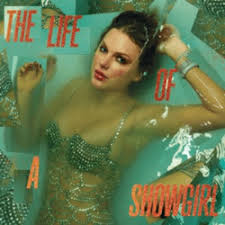
The Life of a Showgirl arrives October 3, 2025, as Taylor’s 12th studio album. She conceived and recorded it largely during the European leg of her Eras Tour, in between performances, channeling life on the road into her art. Working with longtime collaborators Max Martin and Shellback (plus herself), she aimed for a tightly focused, high-energy pop record eschewing multiple outside writers or features (save for Sabrina Carpenter on the title track).
This album comes hot on the heels of The Tortured Poets Department, which was more introspective and brooding. Showgirl feels like a pivot toward brightness, forward motion, and performative flair.
Table of Contents
ToggleWhat Works: Strengths & High Points
1. Energetic Production & Sonic Consistency
One of Showgirl’s greatest assets is its sonic clarity. By restricting the main production team to just Martin, Shellback, and Taylor, the album avoids scattershot textures. The sound leans pop with soft rock touches, shimmering synths, and guitar elements—there’s a cohesion that many modern pop records struggle to maintain. The album has just enough sonic variety (acoustic, midtempo grooves, anthems) to keep interest without losing identity.
2. Lyrical Intimacy & Self-Awareness
Taylor continues to show her strength in crafting vivid, emotionally resonant lines even when the subject is glamor and spectacle. Tracks like “The Fate of Ophelia” show her weaving literary references, while “Ruin the Friendship” and “Elizabeth Taylor” ground her glamour in relational stakes. There’s a tension she plays with: showmanship vs. authenticity, persona vs. inner life.
3. Boldness & Playfulness
This is Taylor leaning into theatricality in a way she hasn’t always risked before. The album doesn’t hide from spectacle; it invites it. Songs like “Cancelled!” confront themes of cancel culture, misogyny, and public scrutiny with biting wit and defiance. The title track (with Sabrina Carpenter) gives her space to meditate on the cost and thrill of being a “showgirl,” making the motif more than just aesthetic.
4. Fan & Commercial Momentum
From a business/impact angle, Showgirl is doing what big Taylor albums tend to: breaking records, igniting conversation, and offering a moment (or an era). It became the most pre-saved album in Spotify history and broke single-day streaming records in 2025. The rollout—teasers, visuals, theater events—amplifies the music’s themes.
What Doesn’t Land Fully: Critiques & Weak Spots
1. Inconsistent Depth Across Tracks
While there are standout moments, some tracks feel more surface-level than they should. Critics have flagged songs like “Wi$h Li$t,” “Wood,” and “Actually Romantic” as lyrically cringey, or trying too hard to provoke. “Actually Romantic,” in particular, has drawn commentary for coming across as petty more than poetic.
At times, the tension between glamorous persona and personal vulnerability is underexplored; the album leans more often into the shine than the shadows, which may leave listeners wanting more emotional risk.
2. Expectation vs. Innovation
Because Taylor has set such high standards for reinvention, there’s a recurring critique that Showgirl doesn’t push boldly enough. Some observers suggest it lacks the dramatic surprises or boundary-pushing one might expect from the mid-career era of a superstar. At times, it borders on comfortable great pop, but not always groundbreaking.
3. Structural Pacing & Momentum
With 12 tracks and a tight runtime (~41:40), Showgirl is leaner than many of Taylor’s past albums. That’s a strength in focus, but also a limitation: there’s little room for extended narrative arcs or diversions. Some transitions feel abrupt; the album occasionally feels like a collection of singles rather than a unified journey.
4. Fan/Listener Polarization
Given how self-referential and personal the lyrics are, some fans will love the intimacy and directness; others will read into “disses” or conspiratorial references in ways that distract from the music. The risk in Taylor’s kind of lyricism is overinterpretation or backlash especially when lines tread into territory of public feuds or critique. Some critics already objected to what they saw as “score-settling detours” in an otherwise bright album.
Standout Tracks & Moments
“The Fate of Ophelia” — A superb opening: literary, hooky, and luminous. It sets the tone well for the balance Tayler aims to strike between depth and pop.
“Elizabeth Taylor” — Glamorous while grounded, the song plays to her strengths in persona-driven songwriting.
“Cancelled!” — Bold, confrontational, necessary—even if imperfect, it’s one of her most striking statements this era.
Title track, “The Life of a Showgirl” (with Sabrina Carpenter) — As a closing statement, it carries emotional weight: balancing performative spectacle with inner cost.
“Actually Romantic” — A controversial pick. Some find its tone too cathartic or judging; others see it as a callback to her earlier “revenge-pop” era.
These tracks show both the peaks and limits of what the album tries to accomplish.
Overall Take
The Life of a Showgirl is a confident, ambitious return to glittering pop after a darker, heavier previous album. It embraces spectacle, reclaims performance as art, and reasserts Taylor’s place in mainstream pop with flair. It doesn’t always land perfectly—some tracks lean too glossy, some lyrics are sharper than they need to be, and the experimentation is tempered—but it’s full of emotion, intention, and moments of stardust magic.
For longtime fans, it offers a new dimension: not just the introspective Taylor, or the narrative-driven Taylor, but a Taylor who wants to celebrate the risk, cost, and beauty of being in the spotlight. For newer listeners, it’s still a sleek pop package with hooks and personality. I’d give it somewhere in the 7 / 10 range (or “good to very good”)—a strong entry in her catalog, though not her deepest.
Hi, I do believe this is a great website. I stumbledupon it 😉 I will come back once again since i have saved as a favorite it. Money and freedom is the best way to change, may you be rich and continue to help other people.